Full Mouth Rehabilitation in Champaign, IL
When teeth are worn, broken, or failing all at once, patching them one at a time stops working. Full mouth rehabilitation rebuilds your bite so you can eat comfortably and smile without thinking about it. At Q Dental in Champaign, IL, the whole case is planned digitally before a single tooth is touched, and we do the least amount of work that gets you there.
Signs of a bite that is wearing down
A real case from our Champaign office. These are the things we check at a rehabilitation consultation.
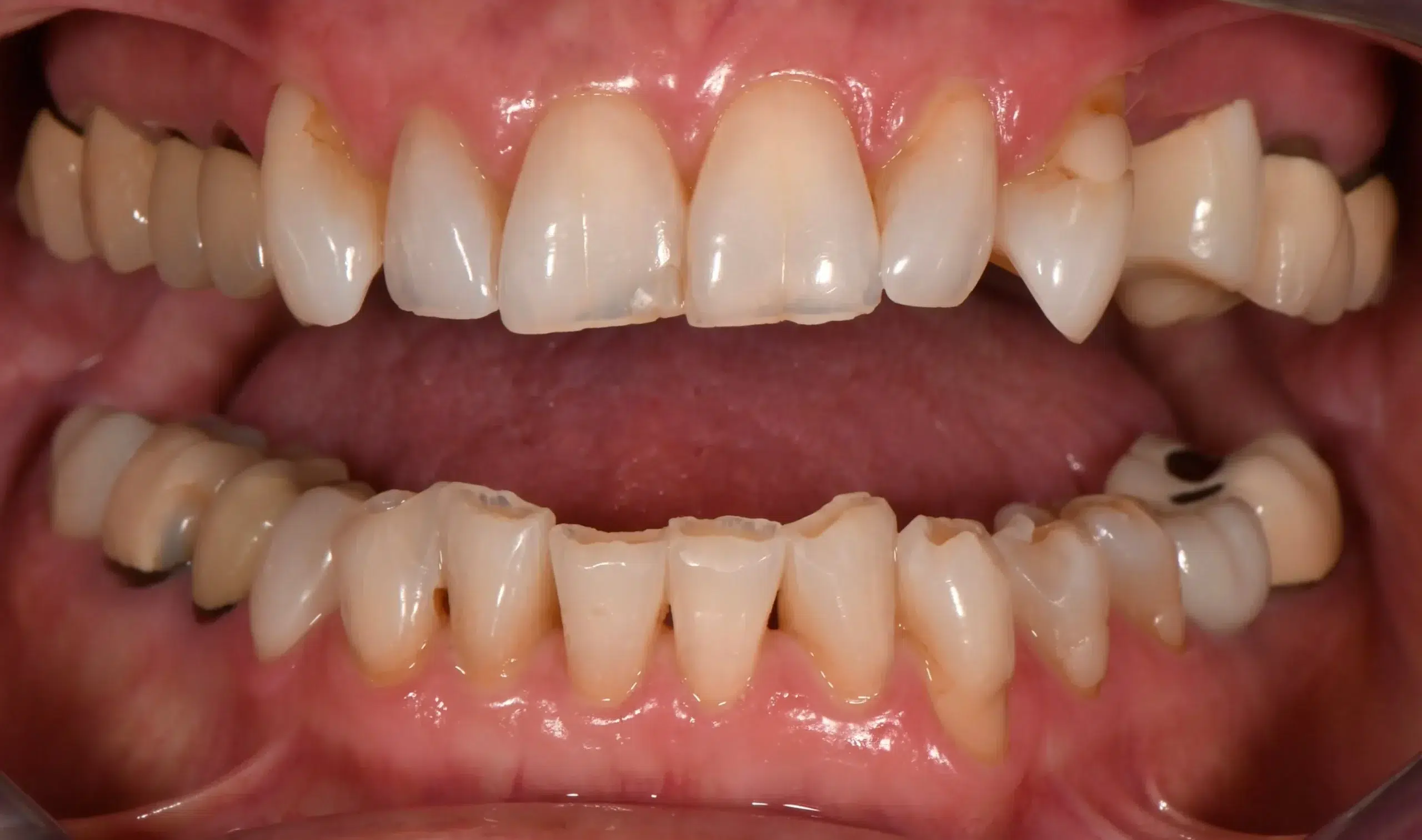
- 1Worn, chipped lower front teeth
The edges are flat and uneven from years of grinding and a bite that no longer protects them.
- 2Uneven, shortened upper edges
Front teeth look shorter than they used to. Wear has erased the natural shape.
- 3Old dental work failing
Dark margins and a worn, discolored crown on the upper left. Patching one tooth at a time has stopped keeping up.
- 4Aging metal fillings
Large amalgam restorations with cracks around them are a common reason back teeth start breaking.
- 5Bite has closed down
With the front teeth worn short, the jaw sits closer together. The remaining teeth take more force than they were built for.
- 6Gum recession and notching
Exposed roots and wedge-shaped notches near the gumline point to heavy forces and erosion, which the plan has to address first.
When full mouth rehabilitation makes sense, and when it doesn’t
Full mouth rehabilitation is for people whose teeth have been wearing down or breaking for years, often from several causes at once. It is also not the answer to everything, and we will tell you when it isn’t.
Worn, broken, or failing teeth across the mouth
Front teeth that look shorter than they used to. Teeth that crack one after another. Crowns and fillings from years ago that keep failing. A bite that has closed down so the face looks shorter. Avoiding foods or chewing on one side because of worn teeth. When more than one of these is true, a single fix at a time usually stops working.
When one tooth at a time still works
Not everyone who asks about rehabilitation needs it. If the breakdown is limited to a few teeth and the bite is stable, a crown, an onlay, or bonding on those teeth may be all it takes. We start from what you want your teeth to look like and do, then work backward to the smallest set of procedures that gets there.
Grinding, erosion, and gum health
Whatever wore the old teeth down will wear the new ones down too. Grinding and clenching, acid from reflux or diet, and gum disease are found and addressed as part of the plan, because fixing the teeth without the cause means the new work fails the same way.
Rehabilitation, smile makeover, or All-on-X?
These three get mixed up, and the right one depends on how much of your mouth is involved and whether the teeth can be saved. All three start with the same consultation, and we will tell you which one fits.
Full mouth rehabilitation
A planned rebuild of most or all of your teeth when they are worn, broken, or failing together. Crowns, onlays, veneers, implants, and bite correction, combined into one sequenced plan.
- What it fixes
- Worn or broken teeth, a collapsed bite, old dentistry failing, trouble chewing
- Visits
- Depends on the extent of the work. Some cases finish in a few visits, others are phased over months
- Best for
- Breakdown spread across the mouth, usually from grinding, erosion, or missing teeth
Smile makeover
Changes how your front teeth look: shape, color, spacing. Usually veneers, bonding, or whitening, without rebuilding the bite.
- What it fixes
- Color, shape, and spacing of the teeth that show when you smile
- Visits
- 2 to 3 for most veneer and bonding cases
- Best for
- Healthy teeth and a stable bite where appearance is the main goal
All-on-X
When the teeth in an arch cannot be saved, a fixed set of new teeth on four to six implants. See our All-on-X page →
- What it fixes
- Teeth that are too far gone to rebuild, or a failing denture
- Visits
- Surgery with temporary teeth within 24 hours, final teeth after healing
- Best for
- An arch where most teeth are missing or cannot be saved
The Q Dental Smile Design Experience
Step 1: Consultation and Records
It starts with a conversation about what bothers you and what you want your teeth to do. Then we take 3D scans, photos, and a digital bite record. The goal of this visit is to find the cause of the wear, not just the damage, because the cause decides what will last.
Step 2: Digital Design
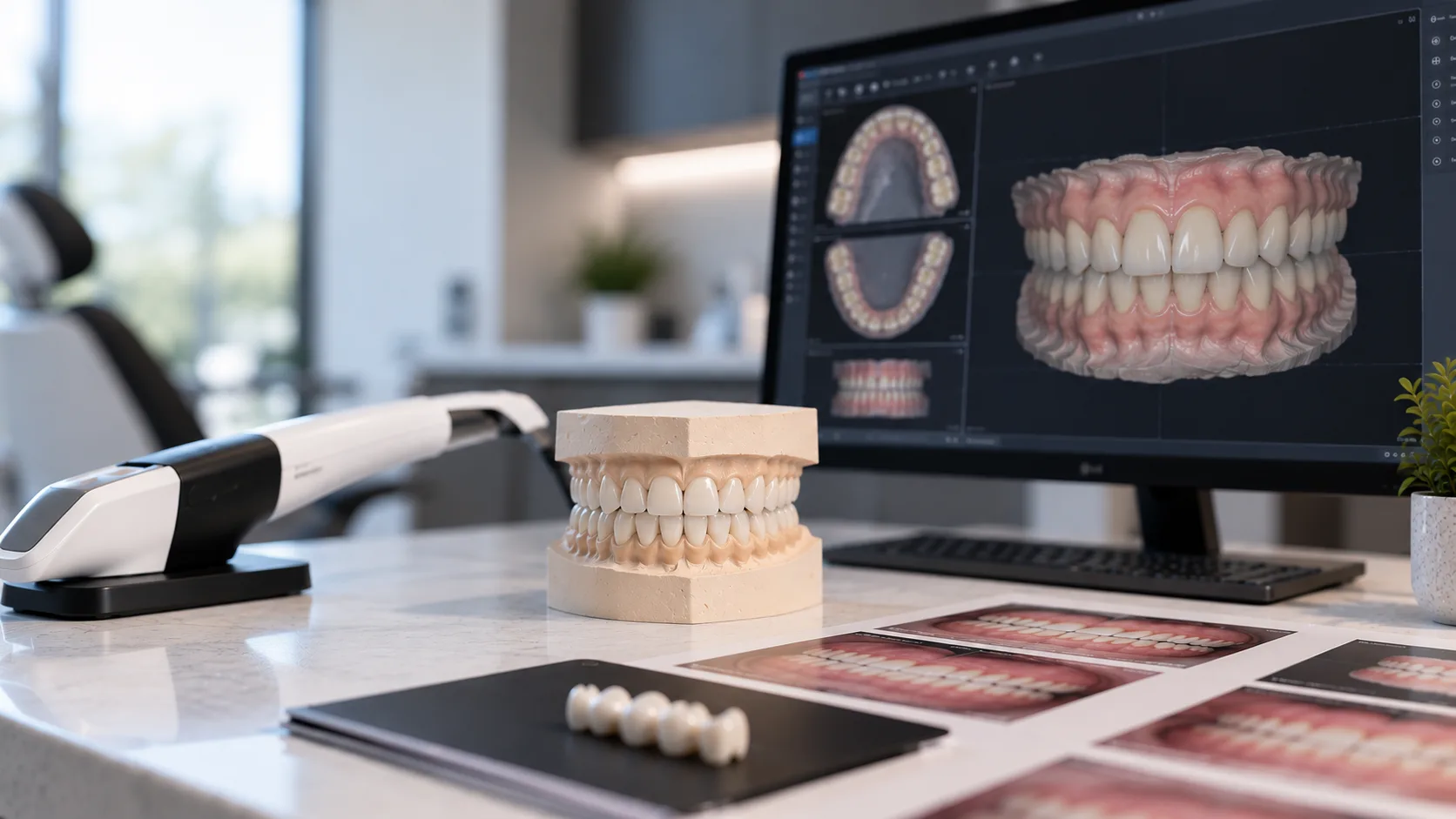
Cases like these need a lot of planning. Your new teeth and bite are designed on your own scans before anything is touched. You see the result, we adjust it with you, and you approve the plan and written estimate before treatment begins.
Step 3: Treatment in Phases
Work is sequenced so each step sets up the next: gum health first with a cleaning, then the teeth, with implants or orthodontics placed where the plan calls for them. Guides made from your approved design keep the result on plan. Oral or IV sedation is available for longer visits, and you have temporary teeth made from the design throughout.
Step 4: Final Teeth and Protection
Final restorations are placed and the bite is checked and fine-tuned. You get a night guard to protect the work, and regular recare visits keep it that way.
Clear answers about full mouth rehabilitation in Champaign-Urbana
Rehabilitation is the biggest of our cosmetic and restorative options, so it comes with the most questions. Here are the ones we hear most.
What is full mouth rehabilitation?
Is it the same as a smile makeover?
Is full mouth rehabilitation the same as All-on-X?
What is included in the plan?
How many visits does it take?
Can I be sedated?
Will I be without teeth at any point?
Does it hurt?
Why did my teeth wear down in the first place?
Who does the work?
How much does full mouth rehabilitation cost?
Does insurance cover any of it?
Have a question about cost? See how insurance and financing work at Q Dental.