Full-Arch Dental Implants (All-on-X) in Champaign-Urbana
Understand your options for full-arch implant teeth at Q Dental in Champaign-Urbana, including All-on-4, All-on-6, All-on-X (also called hybrid dentures), and snap-in dentures. After a complete evaluation, our team can provide a personalized treatment plan.
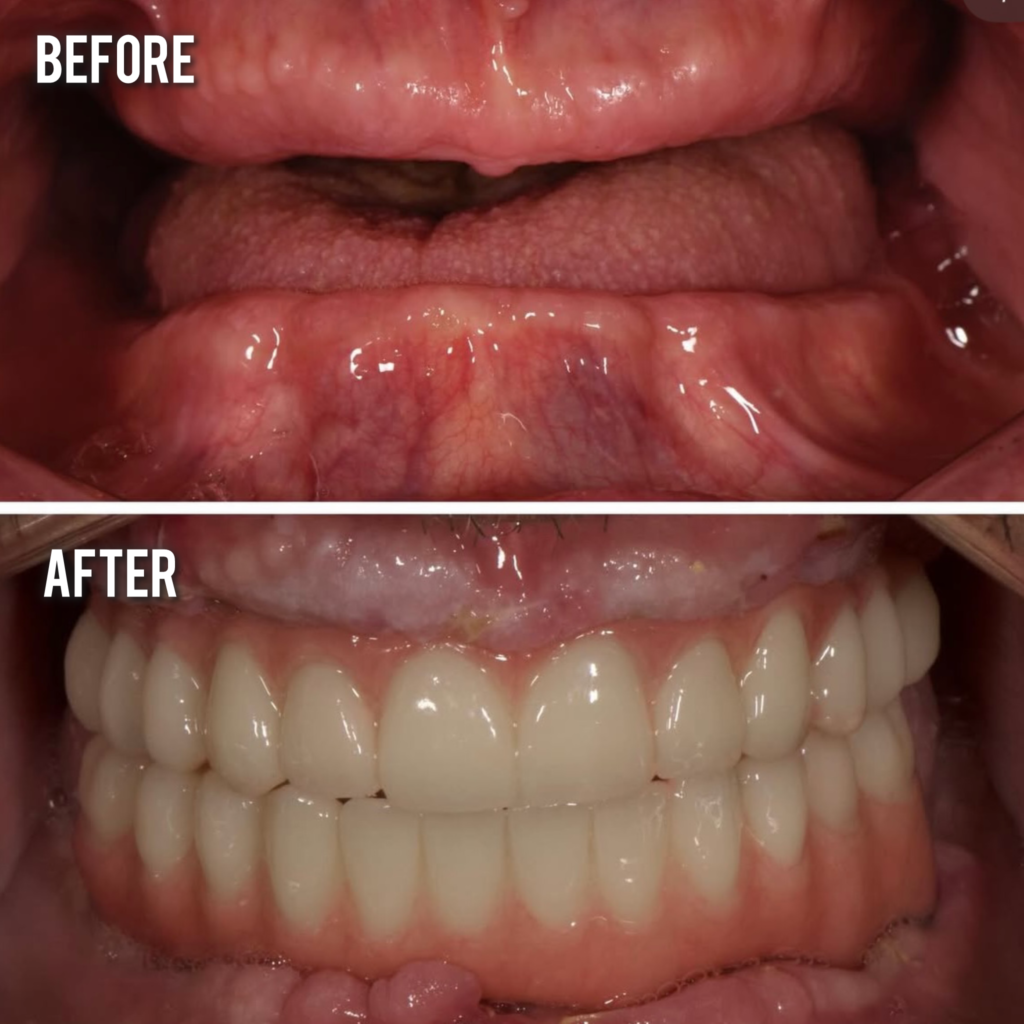
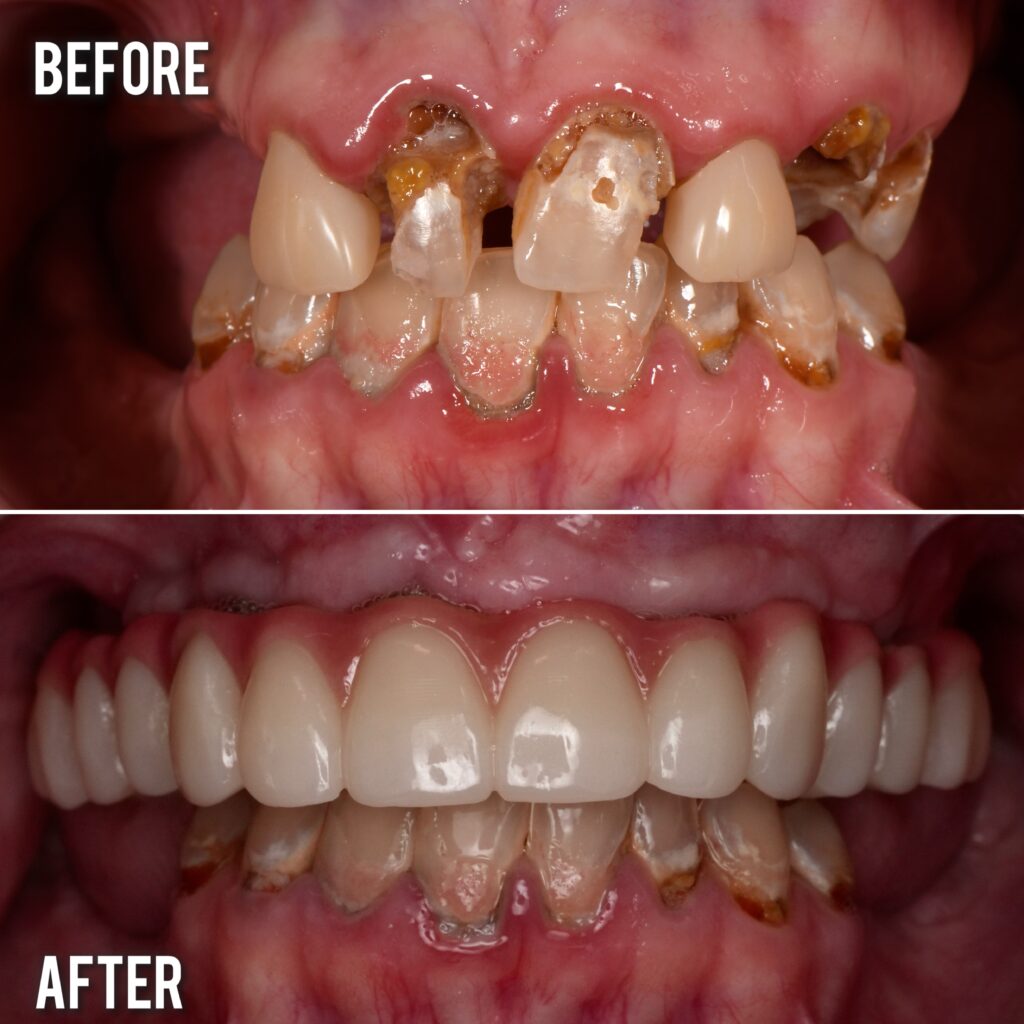
What does All-on-X or implant supported dentures actually mean?
All-on-X is a general term for replacing all teeth in one dental arch with a prosthetic supported by several dental implants. The “X” means the number of implants is selected for the individual rather than assumed in advance. You may also hear a fixed All-on-X bridge called a hybrid denture or a fixed implant denture.
Upper or lower teeth
One arch means one complete row of teeth: either the upper jaw or the lower jaw. A fee described as “per arch” applies to one of those rows, not automatically to both.
Upper and lower teeth
Some people use “full-mouth” to mean both arches, while others use it when discussing only one failing arch. We specify upper, lower, or both so the scope is clear.
A full arch supported together
A full-arch bridge does not require one implant for every missing tooth. A carefully planned number of implants can work together to support an entire arch of replacement teeth.
All-on-4, All-on-6, and All-on-X describe the same broad treatment category. The number refers to how many implants support an arch. More is not automatically better; implant number and position depend on bone, anatomy, bite forces, restorative space, and the treatment design.
Snap-In Dentures vs. All-on-X
Both options use dental implants, but they differ in how they feel, function, and are maintained. Q Dental offers both in our Champaign-Urbana office, and we will help you choose the one that fits your needs.

Snap-In Dentures
A removable denture that connects to implants for more support than a traditional denture.
- Removability
- Removed by the patient each day.
- Stability
- More stable than a traditional denture, but some movement may still occur.
- Feel and comfort
- Rests partly on the gums and may feel bulkier in the mouth.
- Chewing ability
- Improves chewing compared with a traditional denture, with some food limitations.
- Maintenance
- Removed for daily cleaning; attachment components may need periodic replacement.
- Long-term durability
- The denture and attachments can wear over time and may need relining, repair, or replacement.

All-on-X
A fixed full-arch bridge supported by implants and designed to remain in place during daily life.
- Removability
- Stays fixed in place and is removed only by the dental team when needed.
- Stability
- Designed for firm, dependable stability without daily removal.
- Feel and comfort
- Typically feels slimmer and more like a fixed set of teeth.
- Chewing ability
- Provides strong chewing function after healing, with guidance based on your clinical needs.
- Maintenance
- Cleaned in place every day like natural teeth, including underneath the bridge, with regular professional care.
- Long-term durability
- Zirconia is highly durable, although implants, components, and the bridge still require ongoing care.
Printed temporary teeth, zirconia final teeth, and acrylic snap-in dentures
Your restoration changes as treatment progresses. Printed teeth support the temporary healing stage, zirconia is used for the final fixed All-on-X restoration after healing and the necessary clinical checks are complete, and acrylic is reserved for removable clip-on/snap-in dentures rather than the fixed restoration.
Acrylic snap-in dentures
Acrylic is offered only for removable clip-on/snap-in dentures. It is not used for the fixed All-on-X restoration, but can be a practical option when a removable design is the right choice for comfort, cleaning, and retention.
Treatment stage: snap-in denturesPrinted temporary teeth
Printed teeth are used during the provisional stage while your implants and surrounding tissues heal. They can be produced efficiently and adjusted as your bite, comfort, and restorative design are evaluated before the final teeth are made.
Treatment stage: temporary healing teethZirconia final teeth
Zirconia is a strong ceramic material used for the final fixed All-on-X restoration. It offers a smooth surface and natural-looking tooth color, with the bridge designed around implant support, available space, appearance goals, and a carefully balanced bite.
Treatment stage: final fixed restorationFull-Arch Dental Implants in Champaign-Urbana
Losing teeth affects more than your smile—it impacts how you eat, speak, and show up in the world. For those struggling with extensive tooth loss or ill-fitting dentures, All-on-X implants (also called hybrid dentures) at Q Dental in Champaign-Urbana replace a full arch of teeth on four to six implants. For patients who qualify, we deliver temporary teeth within 24 hours of surgery.

What recovery may involve
Recovery varies with the number of extractions, implant placement, grafting, your general health, and how your body heals. Your clinical team will provide instructions based on your procedure.
Pain and swelling
Soreness, swelling, bruising, and tightness are common after surgery. Medication, cold compresses, rest, and following post-operative instructions can help.
Anesthesia and sedation
Treatment involves local anesthesia. For sedation, we bring in a mobile anesthesia group to our Champaign office, with the level chosen according to your health, anxiety, and procedure. Sedation requires appropriate screening and transportation planning.
Time away from work
Many patients plan several days away from work, but physically demanding jobs or more extensive procedures may require longer. Our team can provide more specific guidance after reviewing your customized treatment plan.
Eating during healing
A soft or modified diet is required while implants heal, even when temporary fixed teeth are present. Returning to regular foods is gradual and should happen only when our team confirms it is safe.
Speech and bulk
A full-arch bridge replaces teeth and may also replace missing gum volume, so it can initially feel different. Speech adapts with practice, and provisional teeth can help identify contours that may need refinement.
Cleaning underneath
A fixed bridge still requires daily cleaning underneath. Water flossers, floss threaders, bridge floss, and appropriately sized interdental brushes may be recommended for your specific bridge design.
Smoking, uncontrolled medical conditions, poor oral hygiene, excessive bite forces, and not following dietary restrictions can affect healing and long-term stability. Our team will discuss risk factors that apply to you.
Dr. Kelvin Jung explains full-arch implant treatment
Watch Dr. Kelvin’s answer for a clear introduction to full-arch implant treatment and the questions patients may consider while researching their options.
Clear answers about full-arch dental implants in Champaign-Urbana
These answers provide general education. Your examination, imaging, health history, and treatment goals determine what is appropriate for you.
What is the difference between fixed implant teeth and snap-in dentures?
Fixed implant teeth are secured to the implants and are normally removed only by a dental professional. You brush them in place and clean underneath the bridge every day using tools selected for the space beneath it.
A snap-in denture attaches to implants but is designed for you to remove at home. It is cleaned outside the mouth, while the implants, gums, and attachments are cleaned separately. Snap-in dentures can offer easier cleaning access and additional facial support, while fixed teeth may feel more similar to having teeth that remain in place.
Are hybrid dentures the same as All-on-X?
Who performs All-on-X surgery at Q Dental?
Can I get teeth on the day of surgery, and are those my final teeth?
For patients who qualify, we deliver provisional teeth within 24 hours of implant surgery. This allows you to rest after your procedure and return the following day, rather than wait in the dental chair while your teeth are designed, printed, and stained—a process that can take two to three hours. Eligibility depends on implant stability, bone quality, your bite, and your overall health and treatment plan.
These temporary teeth provide a natural-looking smile while you heal and allow us to assess comfort, appearance, speech, cleanability, and bite. You’ll also have time to share any aesthetic changes you’d like to see in your final smile. Your final teeth are made after healing is confirmed and updated records are taken.
Am I a candidate if I have significant bone loss or have worn dentures for years?
Possibly. Bone loss and long-term denture wear can make treatment more complex, but they do not automatically prevent implant treatment. Three-dimensional imaging can help evaluate bone volume, bone quality, sinus position, nerves, and potential implant locations.
Your plan may involve angled implants, a different number or size of implants, grafting, a removable implant-supported option, or referral for advanced surgical care. If predictable support cannot be achieved, we will explain safer alternatives.
What is the difference between All-on-4, All-on-6, and All-on-X?
The number describes how many implants support one full arch. All-on-4 uses four implants, All-on-6 uses six, and All-on-X means the number is selected according to the patient’s anatomy and treatment needs.
The highest number is not automatically the best plan. Implant location, distribution, bone quality, restorative space, hygiene access, bite forces, and the possibility of future complications all matter. The final number should be selected after diagnostic planning rather than chosen as a marketing package.
Do all my remaining teeth need to be removed, or could some be saved?
All-on-X replaces all of the teeth in the arch being treated, so any remaining teeth in that arch must be removed. However, if enough healthy tooth structure and support remain, a different treatment plan may allow us to preserve your natural teeth instead. During your consultation, we’ll evaluate your remaining teeth and discuss whether All-on-X or a tooth-preserving approach is appropriate for your needs. If only one or a few teeth are missing, see single implants and implant bridges.
How painful is treatment, and what anesthesia or sedation is available?
Local anesthesia is used to numb the treatment area. For sedation, we bring in a mobile anesthesia group, with the level chosen based on your health history, anxiety level, and procedure. Sedation requires screening and may require fasting, an adult escort, and restrictions after the appointment.
After surgery, soreness, swelling, bruising, and pressure are expected to varying degrees. Our clinical team will provide instructions for medication, rest, hygiene, and diet. Severe pain, uncontrolled bleeding, fever, breathing or swallowing difficulty, or symptoms that worsen rather than improve should be reported promptly.
How long will I need off work, and when can I eat regular food?
Many patients plan several days away from work. More time may be appropriate after extensive extractions or grafting, or when work is physically demanding, highly public-facing, or difficult to modify.
A soft or modified diet is normally required during early healing. Fixed temporary teeth do not mean the implants are ready for unrestricted chewing. Food texture is advanced gradually according to healing, implant stability, and our instructions. We give you written recovery and diet instructions for your specific procedure.
Will the teeth look natural, feel bulky, or affect my speech?
Full-arch teeth can be designed with natural-looking tooth shapes, proportions, shade, and gum contours. The restoration may also need to replace tissue volume lost through gum and bone shrinkage, so it can initially feel larger than natural teeth.
Speech changes can occur while your tongue adapts to new tooth positions and contours. Provisional teeth provide an opportunity to assess appearance, lip support, speech, bite, and cleaning access before the final restoration is completed. Some anatomical limitations may affect how thin or compact the final design can be.
What is the difference between zirconia, acrylic, and printed implant teeth?
Zirconia is a strong ceramic commonly used for final fixed bridges. Acrylic teeth are usually connected to a base or framework and can be easier to modify or repair, although they may wear or chip over time.
Printed resin is commonly used for temporary or provisional teeth during healing, although indications vary by material and design. The right choice depends on the treatment stage, implant arrangement, restorative space, bite forces, appearance goals, repair needs, and budget.
How do I clean underneath a fixed implant bridge?
Brush the visible surfaces and the area where the bridge meets the gums. Clean underneath every day using the tools recommended for your bridge, which may include a water flosser, floss threader, bridge floss, or interdental brushes.
The correct technique depends on the amount of space beneath the bridge and the shape of the restoration. Professional implant-maintenance visits are also important because inflammation and plaque can develop even though implant teeth cannot develop cavities.
What happens if an implant fails or the teeth chip, and what ongoing costs should I expect?
If an implant fails to integrate or later loses support, it may need to be removed. Options can include healing and replacement, grafting, changing the implant arrangement, modifying the bridge, or choosing another type of restoration. The appropriate response depends on timing, infection, bone, and the number and position of the remaining implants.
The main ongoing cost is your recare visit and exam. Plan on at least one a year for your upper and lower implant teeth; we recommend two. If you still have natural teeth in one arch, we recommend two a year as well. Beyond that, chipped teeth, worn attachments, loose screws, bite adjustments, professional bridge removal, repairs, hygiene visits, imaging, night guards, and eventual restoration replacement may create ongoing costs. Your written treatment plan and quote lists what is included and what is billed separately. Our full-arch treatment also comes with a 10-year warranty, described below.